


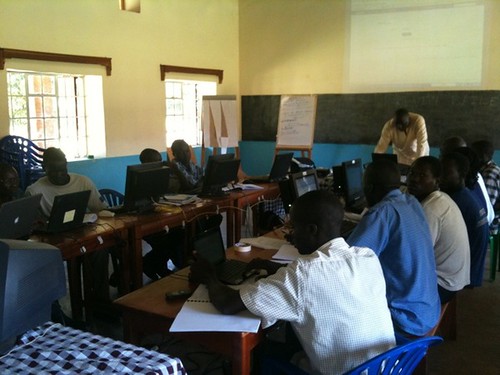
This week, BOSCO is hosting our first ever Web 2.0 training workshop, on site at our office in the Catechists Training Center, Gulu. We are hosting 16 young men and women representing 8 of our rural sites (see site locations here).
They are going to be focusing on learning collaborative, web based applications like Wikispaces, Google Docs, and other social media applications. Our users have already learned how to create their own blogs. You can see their work here.
Upon completion of the workshop these users will return to their rural based ICT sites and will be the primary peer trainers, initiating the Train the Trainer process.
With the arrival of the SEACOM fiber optic cable late this year, many cities across Kenya, Uganda and the East African region experienced higher speed Internet connections at reduced costs. The cable landed on the coast, in Mombasa, Kenya and slowly made its way toward Kampala, Uganda.
Using a local ISP, Uganda Telecom, we received notice that the effects of the SEACOM cable's arrival in Uganda has finally increased the bandwidth we are receiving in Gulu. We were previously using an 256 kbps connection and now we are running at 512 kbps for the same price we were previously paying at 256 kbps.


After a few months of struggles finding new tower alternatives to restore Internet connectivity to our IDP camp sites, the BOSCO technical team has reestablished connectivity at at least 4 of our 6 IDP camp sites which will go back online in the next couple of days.
We had previously been using an old 30 meter TV tower to send a long-range WiFi signal to all of our sites. When we were forcibly taken off of our tower, we scrambled, without much luck, to find a new tower location. After experimentation with NanoStation radio technology, however, the team was able to restore connectivity by mounting the radios to a pole attached to the roof of the Catechist Training Center, our network hub. From this location, we established a connection to our Coope IDP site which then relays the signal to Pagak IDP camp, Jengari IDP camp, and Pabo IDP camp. Confidence is high that we will also be able to reach and connect Lacor IDP camp and Unyama IDP camp using NanoStation radios.
In the future we will also be partnering with Radio Maria for tower use. In exchange for providing their Gulu office with connectivity, some of our equipment will sit on their Gulu tower (see photo above). Radio Maria will also be constructing a tower in Opit, to the East, which will allow us to use that space as a relay point for reaching Pader and Kitgum districts in future deployments.
The Project Team is currently organizing all of our site's volunteer users so that they may resume our Web 2.0 Training of Trainers program. This will allow users to again be collaborating on community development proposals while documenting and sharing their lives with fellow Ugandans and collaborators from around the world. More to come soon!
It’s been a long while since I have updated my blog here. A lot has been happening with BOSCO since I last posted about our human rights monitoring initiative that we are doing.
In fact, you may not have known this, but between the last time I posted and now, I spent about 7 weeks in South Bend, IN working with the BOSCO board of directors and folks at the University of Notre Dame on our initiatives.
I arrived back in Gulu, Uganda last week to continue my “on the ground” efforts, working with people in the IDP camps here to find useful ways to connect them to the outside world with our solar-powered Internet PCs.
Maybe I’ll just start by giving you all an update of where the project is at now and then where I hope it will be going:
Right before I left Gulu for the US at the end of October, we had just found funding to support local capacity building. We realized that if this ICT project was going to be sustainable in the long run, we were going to have to have local, Ugandan, staff available and trained to carry out a lot of the technical computer networking tasks, especially as we expand to new sites in northern Uganda.
We were able to hire two new Ugandan staff, one as a “Technical Assistant” and the other as a “Project Coordinator.” This brings our team total in Gulu, including myself, to 6 people. We now have four Ugandan staff—our Executive Director, Fr Joseph Okumu, (seen here talking about the project) is a local Diocesan priest who is very politically and socially connected in this area and brings a ton of development expertise.
The next piece of big news is that we were able to secure an agreement with a group of local partners to expand our network to 12 new sites east of Gulu into Kitgum and Pader Districts (map of northern Uganda here). We will provide connectivity to a local NGO looking to setup ICT resource centers for youth who were formerly abducted by the LRA and have returned home. Also, we are connecting the local government offices and a couple of vocational training schools to our network. It is hard to imagine that until now, even the local government offices in district headquarters (a district here is like a state in the U.S.) still do not have access to Internet or the infrastructure for reliable service in the year 2009. We are hoping to setup an e-governance concept whereby people in rural outposts will be able to communicate and collaborate with their elected officials at the district headquarters.
We hope to begin deploying at these new sites in the next couple of months. We also will have the help of a Notre Dame engineering student this summer who is being sponsored by Notre Dame’s Center for Social Concerns in a summer service/internship capacity.
As for what is next on the horizon: Much of what I have begun here on the ground in Gulu and at Notre Dame will require my continued involvement into next year. Last December, when I began raising funds to support my involvement, I originally had committed to one year of service with BOSCO. As I grew comfortable with my role it has taken on something like a full-time management role. I am very invested in the future of the organization and I was lucky enough to have great support and prior experience in Uganda which made for a smooth transition into my work in Gulu.
As a final note, I came across a reflection I was reading on how we can always strive to be more compassionate with those we interact with and those we are serving. This reflection basically says: compassion is not a gesture of sympathy for those who are less fortunate or who grow up in places of violence or destruction; compassion is not a bending toward the underprivileged from a privileged position; it is not a gesture of pity either; compassion means going directly to those people and places where suffering is most acute and investing a part of your life with them; it is about learning from them and listening to their stories while reaching out to offer your own story, giving a helping hand where possible. I think that is what I’m striving to do and I hope that is what the BOSCO project is ultimately about.
-Kevin
![Reblog this post [with Zemanta]](http://img.zemanta.com/reblog_e.png?x-id=77cbf60e-44e8-420e-ac93-325d450590e3)

 BOSCO Newsletter